


Two Minutes of Movement Can Add a Year to Your Life. Here's the Science.
Updated: Aug 14

You've probably heard some version of this before. Exercise more. Sleep better. Eat more vegetables. It sounds simple until you're standing in your kitchen at 7pm, too tired to cook a proper meal, wondering where the energy for a workout is supposed to come from.
Here's the thing. The latest science isn't telling you to do more. It's telling you something much more interesting than that.
If you're over 50 and looking for a simple starting point, the free guide below was built for exactly this. → Grab the free guide here
The Study That Changed the Conversation
In January 2026, researchers at the University of Sydney published a large population study following 59,078 people from the UK Biobank. They wanted to answer a specific question: what is the bare minimum combined change in sleep, movement, and nutrition that actually adds years to your life?
The answer stopped a lot of people in their tracks.
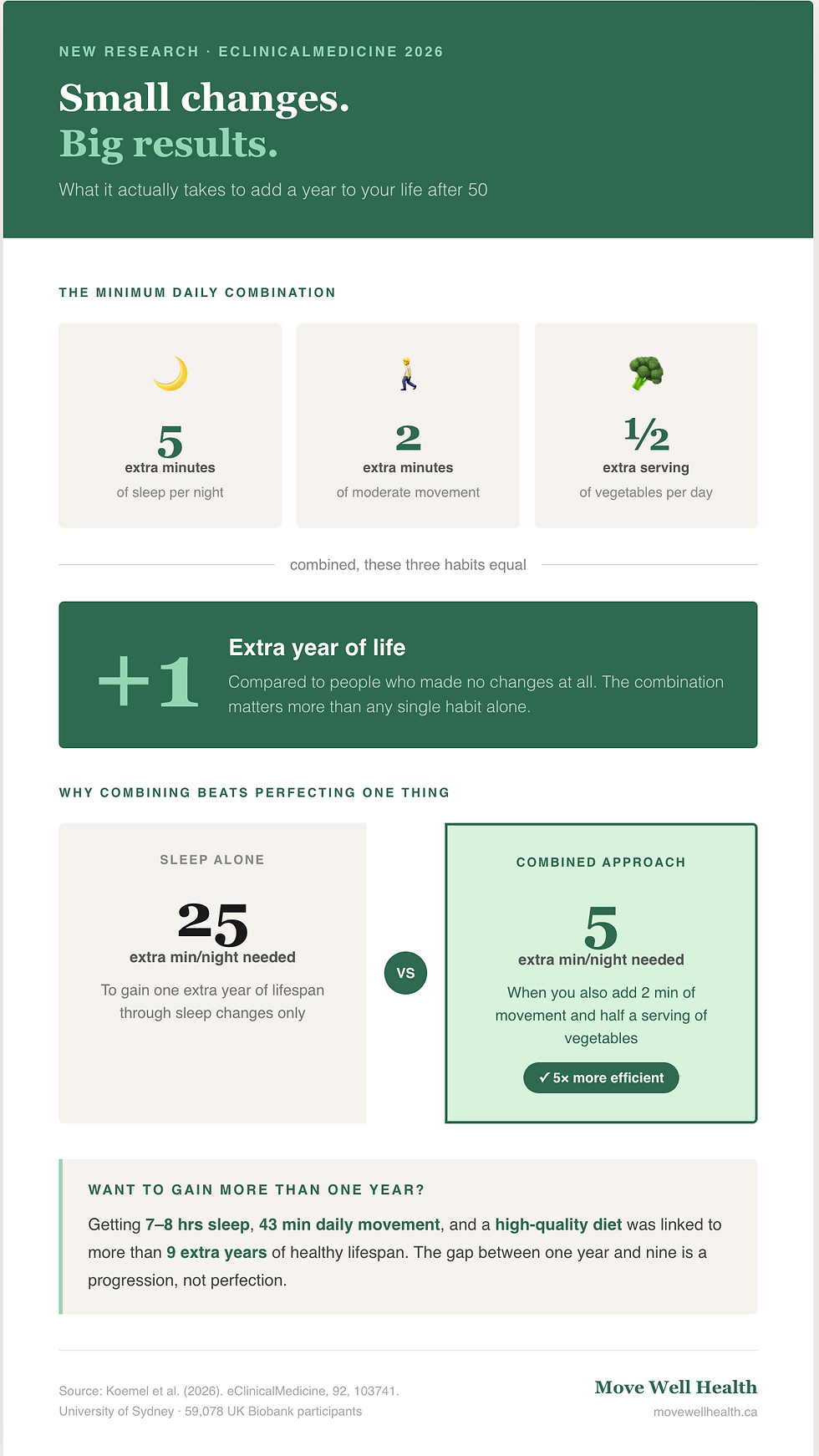
Adding just 5 minutes of sleep, 2 minutes of moderate movement, and half a serving of vegetables per day was associated with one full year of additional lifespan, compared to people who changed nothing (Koemel et al., 2026).
Two minutes of movement. Half a carrot. Five minutes of sleep. That's not a typo.
Why Combining Matters More Than Perfecting One Thing
The most important finding wasn't the numbers themselves. It was what happened when the researchers looked at the three behaviours together versus separately.
When you rely on sleep alone to add that extra year, you need 25 additional minutes a night. But when you add 2 minutes of movement and half a serving of vegetables alongside it, you only need 5 extra minutes of sleep to get the same result.
Sleep, movement, and nutrition share overlapping effects on how your body regulates energy, manages inflammation, and repairs tissue overnight. Each one makes the others work better. That's why small changes across all three add up to more than any one change could on its own.
The lead researcher, Professor Emmanuel Stamatakis, put it this way: this argues against an all-or-nothing approach. Smaller gains across several areas at once may matter more than trying to overhaul one behaviour in isolation.
For anyone who has been waiting to feel ready to commit to a full program, that's worth sitting with. And if fear of making things worse is part of what's keeping you stuck, why pain is information, not a stop sign is a good companion read.
What This Looks Like in Real Life After 50
The study participants starting from the lowest baseline were sleeping around 5.5 hours a night, doing about 7 minutes of moderate movement daily, and eating a low-quality diet. Sound familiar? That's closer to average than most people admit.
Physical activity turned out to be the strongest driver of benefit within the combined model. A 2026 Lancet meta-analysis published alongside this study showed meaningful reductions in mortality risk with even small increases in moderate movement.
That matters for adults over 50 who are dealing with joint pain, stiffness, or recovering from injury. The goal is not a perfect workout. It's consistent, appropriate movement that your body can actually handle and build on. If you're wondering where resistance training fits into this picture, why strength training matters more than ever after 50 walks through that in more detail.
Two minutes of brisk walking. Taking the stairs. A few squats at the kitchen counter. These are not consolation prizes. They are the actual starting point.
The Ceiling Is Much Higher
The same study found that getting 7.2 to 8 hours of sleep, 43 minutes of moderate daily activity, and a high-quality diet was associated with more than 9 additional years of lifespan and healthspan compared to the lowest baseline. If you want to understand the difference between those two terms, healthspan vs lifespan: what's the difference and why it matters is worth a read.
Nine years.
The gap between adding one year and adding nine years is a progression. And it starts with two minutes.
Start Where You Actually Are
Thirty years of clinical work has shown me the same pattern over and over. The people who wait for the right time, the right plan, the right energy level, tend to wait a long time. The people who start small, with something their body can actually do right now, build momentum that eventually takes them somewhere meaningful.
This research gives that pattern a number. Small combined changes work. And they work even if the individual changes feel almost embarrassingly small.
You don't have to overhaul your life. You have to start somewhere.
If you're over 50 and not sure where that somewhere is, the free guide below is a good place. Five days of joint-friendly habits that take less than 10 minutes each, built around exactly the kind of combined, small-step approach this research points to. → Grab the free guide here
Frequently Asked Questions:
Is it really true that just 2 minutes of movement a day makes a difference?
Yes, according to a 2026 University of Sydney study following nearly 60,000 people. The key finding was that combining small changes across sleep, movement, and nutrition produced more benefit than focusing on any one alone.
Why does combining sleep, movement, and nutrition work better than improving just one?
Each one makes the others work better. They share overlapping effects on inflammation, energy regulation, and tissue repair overnight. Small improvements across all three add up to more than one large change in isolation.
What counts as moderate movement for someone over 50 with joint pain?
Two minutes of brisk walking, taking the stairs, or a few bodyweight movements at the kitchen counter all count. The goal is consistent movement your body can handle and build on, not a perfect workout.
What's the difference between lifespan and healthspan?Lifespan is how long you live. Healthspan is how many of those years you spend functioning well and moving independently. The research found that higher levels of all three behaviours were associated with over 9 additional years of both.
About the Author:
Dr. Melanie Wintle, DC, is a licensed chiropractor and corrective exercise specialist (ISSA) with over 30 years of clinical experience. She is the founder of Move Well Health, where she works with adults 50+ on strength training, mobility, and rehab strategies that support long term joint health and independence.
References
Koemel, N. A., Biswas, R. K., Ahmadi, M. N., Teixeira-Pinto, A., Hamer, M., Rezende, L. F. M., Mitchell, J., Leech, R. M., Sawan, M., Allman-Farinelli, M., Dumuid, D., Bauman, A., Maher, C., Barrett, S., Chow, C., Gibson, A. A., Raubenheimer, D., Hocking, S. L., Williams, K., Cistulli, P. A., Simpson, S. J., & Stamatakis, E. (2026). Minimum combined sleep, physical activity, and nutrition variations associated with lifeSPAN and healthSPAN improvements: a population cohort study. eClinicalMedicine, 92, 103741. https://doi.org/10.1016/j.eclinm.2025.103741
Ding, D., et al. (2026). Deaths potentially averted by small changes in physical activity and sedentary time: an individual participant data meta-analysis of prospective cohort studies. The Lancet.
Disclaimer
This site offers health, fitness, and nutritional information and is designed for educational purposes only. You should not rely on this information as a substitute for, nor does it replace, professional medical advice, diagnosis, or treatment. If you have any concerns or questions about your health, you should always consult with a physician or other health-care professional. Do not disregard, avoid, or delay obtaining medical or health-related advice from your health-care professional because of something you may have read on this site. The use of any information provided on this site is solely at your own risk.


Comments