


Understanding Menopause and Joint Pain: A Guide for Women Over 50
Updated: Aug 28

If your joints started aching somewhere around the same time as hot flashes and disrupted sleep, you probably figured it was just getting older. Many women do.
But here's what most women never get told: menopause directly affects your joints, your tendons, and how your body responds to inflammation. And once you understand why, the path forward gets a lot clearer.
If your joints started feeling different during perimenopause or menopause, you are not imagining it, and you are not alone. There is a biological reason this is happening, and it has a name.
If you're tired of guessing what will help, a good place to start is the free guide below. Five days of simple joint-friendly habits designed specifically for this stage of life. → Grab the free guide here
Estrogen Does More Than You Think
Estrogen isn't just a reproductive hormone. It plays a significant role in keeping your joints comfortable and your connective tissue strong.
When estrogen levels drop during perimenopause and menopause, a few things happen:
Synovial fluid, the natural lubricant inside your joints, decreases. Less lubrication means more friction, more stiffness, and that grinding sensation that wasn't there five years ago.
Collagen production slows down. Collagen is what gives your tendons, ligaments, and cartilage their structure. Less collagen means more vulnerability to strain and slower recovery from activity.
Inflammatory responses increase. A 2025 study published in the Journal of Clinical Endocrinology and Metabolism, drawing on data from the Study of Women's Health Across the Nation, found that systemic inflammation increases during the menopause transition, contributing directly to joint discomfort and musculoskeletal symptoms.
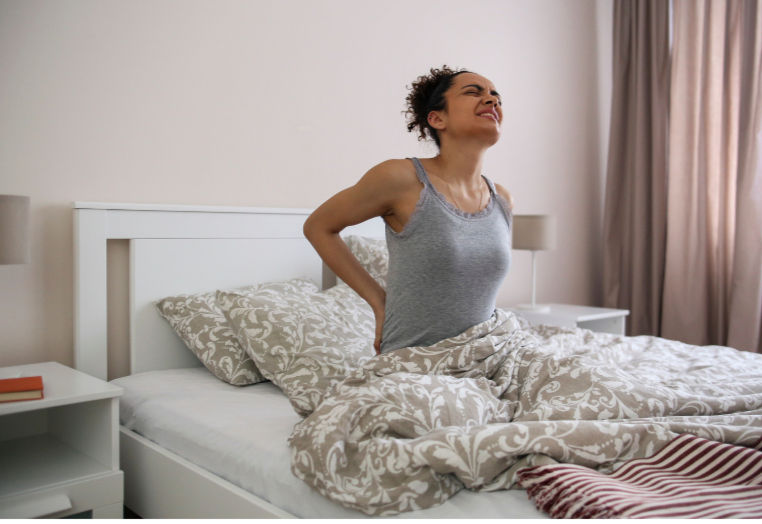
This is why your hips feel stiff when you get out of bed. Why your knees ache after sitting for an hour. Why that shoulder issue that never quite resolved is now a daily thing.
It's a real physiological change, not just you being dramatic.
There's Actually a Name for This Now
In 2024, orthopedic surgeon Dr. Vonda Wright coined the term Musculoskeletal Syndrome of Menopause (MSM) to describe exactly what your body is going through.
The research shows 80% of women in the menopause transition experience MSM symptoms. And yet 40% of them find no structural problems when they seek medical care, which means they leave appointments feeling dismissed, or worse, like they're imagining it.
MSM includes total body pain, frozen shoulder, loss of muscle mass, loss of bone density, rapid progression of arthritis, low back pain, and fat redistribution to the belly. All of it driven by the rapid loss of estrogen.
This isn't just getting older. This is a specific, identifiable syndrome with a specific biological cause. Research suggests that intervention at any stage can meaningfully reduce symptoms, which means it is never too late to start.
The Areas Most Commonly Affected
While every body is different, the joints most frequently impacted by menopause-related changes tend to be:
Hips and knees, especially with morning stiffness
Hands and fingers, which is often the most surprising one for women
Lower back, which may already have some wear from years of movement and loading
Shoulders, particularly if you've had previous injuries
If multiple areas flared up around the same time, menopause is likely a contributing factor, even if no one connected those dots for you.
Morning stiffness in particular is one of the most common early signs. If that resonates, this post breaks it down further: Why Your Joints Feel Stiff in the Morning (And What Actually Helps After 50).
Why Rest and Stretching Often Don't Solve It
The instinct when something hurts is to rest it, stretch it, and wait for it to calm down. And sometimes that works. But with menopause-related joint pain, rest alone often makes things worse over time.
Here's why: muscle tissue helps protect and support your joints. When you reduce activity, you lose muscle mass faster, especially after 50. Less muscle means your joints are carrying more load with less support, which increases discomfort and stiffness.
Stretching addresses flexibility, but it doesn't rebuild the strength your joints need to feel stable and confident under load. If you've been relying on stretching and not getting results, this post explains why the difference between flexibility and mobility matters.
What actually helps is progressive, controlled strength training, the kind that builds capacity gradually without aggravating what's already irritated.
What the Research Actually Supports
A 2022 review in the Journal of Midlife Health found that resistance training significantly reduces joint discomfort and improves function in perimenopausal and postmenopausal women. The key word is progressive, meaning you build gradually rather than jumping into intensity.
Combined with consistent daily movement, adequate protein intake, fibre and anti-inflammatory rich foods, and quality sleep, strength training addresses the root of the problem rather than just managing symptoms.
This doesn't mean you need to be in a gym lifting heavy weights. It means loading your joints progressively through resistance, starting where you are right now. For more on why this matters, check out: 5 Proven Benefits of Strength Training for Osteoarthritis.
A weighted vest is one simple way to add that progressive load, whether you're walking or doing lower body strength work, since it distributes weight evenly instead of stressing a single joint.
Where to Start When Everything Feels Reactive
For a lot of women, the bigger barrier isn't knowing what to do, it's the fear that moving will make things worse. That fear makes complete sense. And it's also one of the main things keeping people stuck. This post goes deeper on exactly that.
The goal isn't to push through pain. The goal is to find the level of movement your body can tolerate today and build from there. That process looks different for every person depending on which joints are involved, what your history is, and how your body is currently responding.
If low back pain is part of what you're dealing with, this is also worth reading before you start: Low Back Pain Not Getting Better? 5 Common Mistakes You Might Be Making.
Ready to start moving in a way that actually works for your body right now?
Download the free guide, Active Again Over 50: A 5-Day Guide to Simple Joint-Loving Habits That Ease Back and Hip Pain and Rebuild Strength, and get a practical starting point without the guesswork.
Frequently Asked Quesitons:
Why do joints hurt during menopause?
During menopause, estrogen levels drop significantly. Estrogen helps maintain synovial fluid (joint lubrication), collagen in tendons and cartilage, and keeps inflammation in check. When estrogen drops, joints become drier, less supported, and more prone to inflammation; leading to stiffness, aching, and pain.
What is Musculoskeletal Syndrome of Menopause (MSM)?
MSM is a term coined in 2024 by orthopedic surgeon Dr. Vonda Wright to describe the cluster of musculoskeletal symptoms caused by the loss of estrogen during menopause. It affects up to 80% of women in the menopause transition and includes joint pain, muscle loss, bone density changes, frozen shoulder, and lower back pain.
Does menopause cause joint inflammation?
Yes. Research including a 2025 study from the Study of Women's Health Across the Nation found that systemic inflammation increases during the menopause transition. This contributes directly to joint discomfort and explains why many women notice their joints become more reactive or slower to recover during this time.
What type of exercise helps with menopause joint pain?
Progressive resistance training is the most evidence-based option. It builds the muscle that supports and protects your joints, slows bone density loss, and reduces overall inflammation. A 2022 review in the Journal of Midlife Health found it significantly reduces joint discomfort and improves function in perimenopausal and postmenopausal women.
Will menopause joint pain go away on its own?
For some women symptoms improve post-menopause, but for many the changes in joint structure, muscle mass, and bone density that occur during the transition are lasting without intervention. The good news is that research shows intervention at any stage can meaningfully reduce symptoms. It is never too late to start.
About the Author:
Dr. Melanie Wintle, DC, is a licensed chiropractor and corrective exercise specialist (ISSA) with over 30 years of clinical experience. She is the founder of Move Well Health, where she works with adults 50+ on strength training, mobility, and rehab strategies that support long term joint health and independence.
References
El Khoudary, S. R., et al. (2025). The relation between systemic inflammation and the menopause transition: The Study of Women's Health Across the Nation. Journal of Clinical Endocrinology and Metabolism, 110 (11), e3566–e3576. https://doi.org/10.1210/clinem/dgaf175
Isenmann, E., Kaluza, D., Havers, T., Elbeshausen, A., Geisler, S., Hofmann, K., Flenker, U., Diel, P., & Gavanda, S. (2023). Resistance training alters body composition in middle-aged women depending on menopause: A 20-week control trial. BMC Women's Health, 23, 526. https://doi.org/10.1186/s12905-023-02671-y
Favro, F., Roma, E., Gobbo, S., Bullo, V., Di Blasio, A., Cugusi, L., & Bergamin, M. (2024). The influence of resistance training on joint flexibility in healthy adults: A systematic review, meta-analysis, and meta-regression. Journal of Strength and Conditioning Research, 39(3), 386–397. https://doi.org/10.1519/JSC.0000000000005000
Wright, V. J. (2024). Musculoskeletal syndrome of menopause. Climacteric, 27(5). https://doi.org/10.1080/13697137.2024.2380363
Disclaimer
This site offers health, fitness, and nutritional information and is designed for educational purposes only. You should not rely on this information as a substitute for, nor does it replace, professional medical advice, diagnosis, or treatment. If you have any concerns or questions about your health, you should always consult with a physician or other health-care professional. Do not disregard, avoid, or delay obtaining medical or health-related advice from your health-care professional because of something you may have read on this site. The use of any information provided on this site is solely at your own risk.


Comments